- Published on
Edge Computing: Why the Future of the Internet Is Everywhere
- Authors
- Name
The Cloud Was Never the Answer
For the better part of the last twenty years, the internet's architecture has been unidirectional: you send data to a central server, it processes it, and sends it back. Cloud computing made this model scalable—Amazon, Google, and Microsoft built massive data centers that could absorb any load.
But this centralized model has a fundamental flaw: distance. Every request must travel to a server, wait in a queue, be processed, and travel back. That round trip, even at the speed of light, adds measurable latency. For a user in Tokyo hitting a server in Virginia, that's not a fraction of a second—it's a noticeable delay.
Edge computing flips this model. Instead of pulling everything to the center, we push computation to the periphery of the network—to routers, base stations, content delivery networks, and eventually, to the devices themselves.
What Is Edge Computing?
At its core, edge computing is about moving the compute closer to the data source. Rather than sending raw sensor data, video streams, or user interactions all the way to a centralized cloud, processing happens at or near the point of origin.
The "edge" is a relative term. It can mean:
- The network edge: Routers and switches at your ISP that route traffic
- The CDN edge: Servers in cities around the world that cache content
- The device edge: Your phone, car, or smartwatch running local logic
- The fog layer: Small data centers in neighborhoods or buildings
Each layer brings computation progressively closer to the user.
The Three Layers of the Edge
| Layer | Where It Lives | Latency | Use Case |
|---|---|---|---|
| Device Edge | Your phone, IoT sensor, camera | < 10ms | Filtering, preprocessing, local inference |
| Fog / Access Edge | Base stations, routers, gateways | 10–50ms | Aggregation, protocol translation, local orchestration |
| Regional Edge | CDN nodes, micro-data centers | 50–200ms | Caching, rendering, AI inference, session state |
The key insight is that not all data needs to go to the cloud. Some data is ephemeral (a sensor reading that's already been acted upon). Some is sensitive (health data, location history). Some is simply too large to justify the round trip (4K video streams, AR point clouds).
Why Edge Matters Now
Five years ago, edge computing was a niche optimization for streaming services. Today, it's becoming the default architecture for several reasons:
1. AI Models Need to Run Locally
The rise of on-device AI—Apple's Neural Engine, Google's TFLite, Qualcomm's Hexagon—has made it possible to run sophisticated models on phones and laptops. A voice assistant that runs entirely on your device doesn't need to send your audio to a server. A camera that detects objects locally doesn't stream video to the cloud.
This is the local-first AI philosophy in action: the same principle that powers edge computing is now powering edge intelligence.
2. Privacy and Regulation
GDPR, CCPA, and emerging AI regulations are making it harder to ship personal data to centralized servers. Processing data at the edge means personal data never leaves the device. This isn't just a legal advantage—it's a trust advantage. Users are increasingly skeptical of cloud providers, and edge computing offers a technical answer to that skepticism.
3. Bandwidth Costs
The internet is drowning in data. Video, IoT sensors, autonomous vehicles, and AR/VR applications are generating terabytes of traffic that centralized clouds can't absorb without astronomical costs. Edge computing reduces the data that needs to be transmitted by processing it locally first.
4. Resilience
Centralized clouds are single points of failure. When a data center goes down, all users are affected. Edge architectures are inherently decentralized and fault-tolerant. If one edge node fails, its neighbors can take over. This is critical for applications like autonomous driving, industrial IoT, and emergency services.
Real-World Examples
Autonomous Vehicles
Self-driving cars generate terabytes of sensor data per hour. Sending all that data to the cloud for processing would be prohibitively expensive and introduce unacceptable latency. Instead, the car runs its perception and planning stacks locally, and only sends summarized insights or anomalous events to the cloud for fleet-wide learning.
Smart Cities
Traffic lights, air quality sensors, and surveillance cameras are already running at the edge. A traffic light doesn't need to send its camera feed to a central server to detect congestion—it can process the video locally and adjust its timing in real time.
Gaming and AR/VR
Cloud gaming (like NVIDIA GeForce Now) is a hybrid: the heavy rendering happens in the cloud, but the final frame delivery happens at the edge. Similarly, AR glasses need to process camera feeds locally to overlay digital content with zero perceptible delay.
E-Commerce
CDNs have been the original edge computing platform for decades. When you visit a website, the images, CSS, and JavaScript are served from a server geographically close to you—not from the company's headquarters. This is edge computing in its simplest form, and it's why the web feels instant.
The Edge-Cloud Continuum
The most important mental model for edge computing is that it's not a replacement for the cloud—it's a continuum.
Device → Fog → Regional Edge → Regional Cloud → Global Cloud
   |         |            |            |              |
   |         |            |            |              |
Local      Aggregation   Rendering    Heavy Compute   Global Scale
Processing  & Routing    & Delivery   & Training      & Orchestration
The right architecture depends on the task:
- Filtering and preprocessing → Device edge
- Real-time control → Fog edge
- Content delivery and inference → Regional edge
- Training and heavy analytics → Cloud
A well-designed system uses all layers, routing each type of work to the most appropriate tier.
Challenges That Still Remain
Despite the momentum, edge computing faces real obstacles:
Hardware Constraints
Edge devices have limited compute, memory, and power. Running a large language model on a phone is still a stretch. The industry is responding with model compression (quantization, pruning, distillation) and hardware acceleration (NPUs, TPUs on-device), but the gap between cloud and edge capability remains wide.
Management Complexity
Managing thousands of distributed edge nodes is fundamentally harder than managing a few hundred cloud servers. You can't just SSH into a router in a random city. Edge orchestration platforms (like AWS Wavelength, Azure Edge Zones, and Cloudflare Workers) are making this easier, but the operational complexity is still significant.
Consistency and State
Distributed systems struggle with consistency. If a user's session state lives on an edge node, what happens when they move to a different network? Edge databases (like Redis Edge or SQLite-based solutions) and event-driven architectures are addressing this, but it's an unsolved problem for many applications.
Cost Economics
Edge infrastructure is more expensive per unit of compute than cloud. You're paying for hardware in locations where you don't have economies of scale. The business case for edge computing depends on whether the value of lower latency, better privacy, or higher reliability outweighs the cost premium.
What This Means for Developers
If you're building applications today, edge computing is no longer optional for several categories:
- Real-time applications: Any app where latency matters (gaming, video calls, trading, autonomous systems)
- Privacy-sensitive applications: Any app handling personal data (health, finance, location)
- Bandwidth-constrained applications: Any app dealing with large media (video, AR, IoT)
- Offline-first applications: Any app that needs to work without constant connectivity
The developer tools are improving rapidly. Cloudflare Workers, Vercel Edge Functions, AWS Lambda@Edge, and Azure Functions all let you deploy code to the edge. You can write JavaScript, TypeScript, or Python and have it execute in a data center 50ms from your user.
For AI, frameworks like TensorFlow Lite, ONNX Runtime, and MLC LLM are making it possible to run models on edge devices. The ecosystem is still young, but the trajectory is clear.
The Bigger Picture
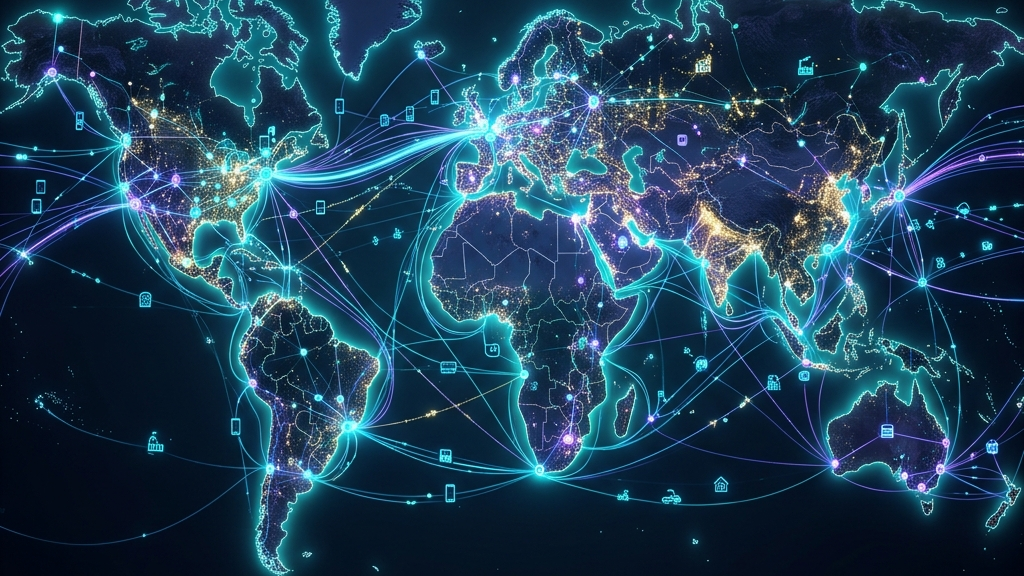
Edge computing is part of a larger shift in how we think about the internet. The old internet was a hub-and-spoke model: everyone connected to a central server. The new internet is a mesh model: computation and data flow in all directions, between devices, between edges, and between edges and the cloud.
This mesh internet is more resilient, more private, more responsive, and more democratic. It doesn't require you to trust a single corporation with your data. It doesn't require you to have a fast connection to get a fast experience.
The future of the internet isn't in the cloud. It's everywhere.